The New Compute
Narrative is the new compute.


The constraint has moved.
Every era of technology has a bottleneck. For a long time it was capital. Then it was compute. For the founders we work with, it’s now narrative.
Building has never been cheaper. Launching has never been louder. A new chip arrives with a keynote, a launch film and a pre-print, all in the same week. So does the one competing with it. Everyone wants the same attention, and attention doesn’t scale.
You know what happens when you open too many tabs on an old laptop. The fan spins up. Everything slows. Then it freezes.
That’s your investor between partner meetings with forty decks open. That’s the senior engineer weighing your offer against two others. That’s the enterprise buyer with a renewal, a reorg and your pilot all landing on the same afternoon. Every new idea you ask them to hold is another tab. Ask them to learn your physics before they understand your company, and the whole thing freezes.
You won’t see the freeze. You’ll see what it leaves behind. The round that doesn’t close. The hire who goes elsewhere. The pilot that quietly stalls. And you can’t quite say why.
If the market can’t run your story, it won’t run your company.
Every unexplained month accrues debt.
We see this a lot. A team spends two years heads-down on the hard part. Nobody writes the story, because there’s nothing to tell yet. Slowly, without noticing, they start to assume everyone else has read the same papers.
Then they come out of stealth. They need a first enterprise contract, a senior commercial hire, a lead investor. And they realise the people across the table don’t have the context to see why any of it matters.
Those people aren’t peer-reviewing the maths. They’re asking a simpler question. Is this the company that wins? Is it worth betting my budget, my fund, my career on?
Without something simple to carry, the story falls apart as it travels. The champion paraphrases it to their boss. The boss paraphrases it to the committee. By the time it reaches whoever decides, it’s someone else’s version of you.
We call this fluency debt. It always comes due. The only question is whether you pay it early, on your own terms, or late, in rooms you aren’t in.
The market rewards the pragmatist.
We’ve met two kinds of technical founder.
The Purist believes the work should speak for itself. Positioning feels like a distraction (or worse, spin). They show up with the raw technical substance and expect the room to meet them there. Honestly, we have a soft spot for Purists. They aren’t wrong about the work. They’re wrong about the room. Every pitch turns into a lecture. Every commercial hire is a fight. They get tired of a market that won’t understand them, without seeing that the market isn’t unwilling. It’s just full. So they keep building a beautiful machine in the dark.
The Pragmatist treats the story as part of the build. They figure out what each audience already understands and start there. They write the story early, before someone else writes it for them. They don’t ask anyone to open a new tab. They use one that’s already open.
Etched is a good example. They build chips that do one thing, run transformers, and they’re up against the most entrenched company in modern semiconductors. They didn’t lead with silicon physics. They led with a line any hardware investor could get instantly. Transformers are the new x86. One sentence, borrowed from a history everyone already knew, and suddenly the incumbent looked like the past. The chips still had to be real (and they were, with first silicon back from TSMC and a billion dollars in orders). But the story made all of that easy to see, fast. Etched started 2026 valued at five billion dollars. By August, it was twenty-one.
Figure AI went the other way. No clever sentence, just proof. In May they pointed a camera at a conveyor belt and let their humanoids sort packages on a public livestream, with no teleoperation and no planned stop. The goal was one eight-hour shift. It ran for days, and millions of people watched. Nobody needed to understand torque sensors. They just watched a robot pick up a box, scan it and put it down. Again and again.
Not everyone was convinced. One roboticist called it closer to a science project. But by then the conversation had moved. People had stopped asking whether the robots worked. They were asking how soon.
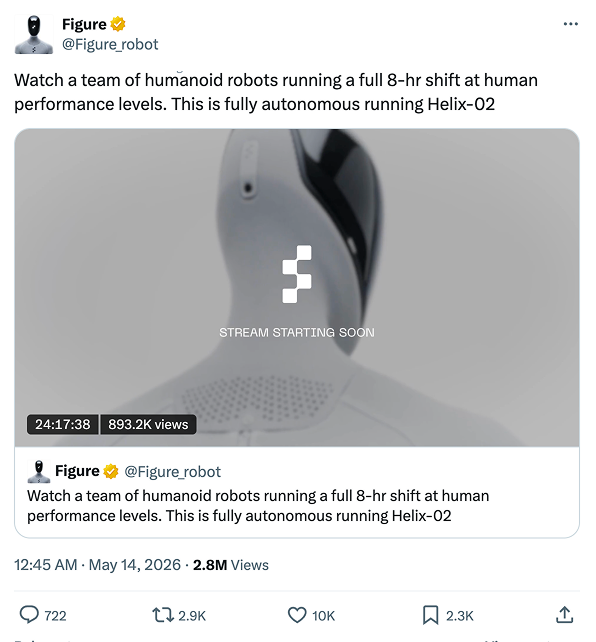
One borrowed a frame the market already had. The other gave the market something to watch. Both made their technology easy to run.
The Pragmatist sets the timeline.
The Purist waits for everyone to catch up.
The first clear story sets the rules.
Whoever defines a category gets to choose its words. Everyone else has to use them.
If Etched owns the story for inference chips, every other challenger spends its time explaining how it’s different from Etched. The first company with a clear story decides how the whole space gets understood. Everyone after that is a variation.
Leave it to someone else and you pay for it, for a long time. Capital costs more. Talent costs more. Every meeting becomes about your difference instead of your progress.
You still need the substance. In deep tech, that’s the price of entry. Without it, there’s nothing to translate. But the category is won on translation.
It’s why we often spend ninety minutes with a founder trying to get their company into one sentence. Not to simplify it. To translate it. When it works, investors, hires and customers can run the company in their heads without the founder in the room. That’s what lets the technical truth travel. And like most things worth building, it’s cheapest to start before you need it.
Compute gets cheaper every year. Attention doesn’t.
Narrative is the new compute.